Subscribe to the Tuesday Briefing
Tuesday Briefing · No. 32 · 15 Sep, 2026
You're not weighing two options. You're waiting for one of them to turn out to be easy.
We think we're weighing two options. We're waiting for one of them to turn out to be the easy. Since neither ever does, we hold the position, which feels like prudence and is a third option with costs of its own, accruing out of sight.
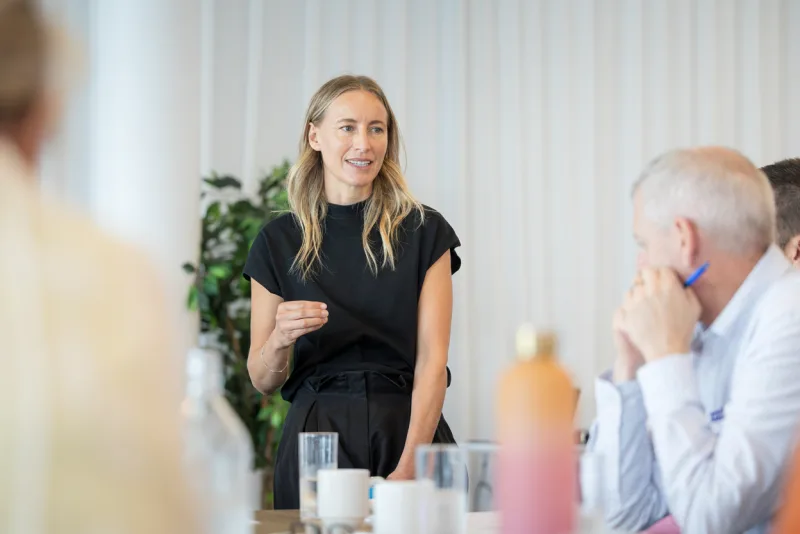
Emily Rust
Founder, Stones
Featured
Pick your hard
Frances Valintine closed her keynote at the Revved summit this month by putting two futures for the country side by side. One shaped by global companies, big tech, bigger money and somebody else's values. Or one we curate deliberately, based on what we decide we want to stand for.
Then: "Both are hard. Pick your hard."
That line covers exactly what most of us are doing when we stall on something - whether it be an action, a decision, or effort.
We think we're weighing two options. We're waiting for one of them to turn out to be easy. Since neither ever does, we hold the position, which feels like prudence and is a third option with costs of its own, accruing quietly in the background.
Have the conversation, and it's uncomfortable, and it might damage something. Don't have it, and you carry it for another six months while it gets worse and your team watches you not deal with it.
Restructure the company and people are hurt. Leave it and pressure becomes unsustainable, for longer, and people end up struggling or leaving anyway.
All of those are hard. The variable is which kind, how long it lasts, and who carries it.
Practical
Which changes the question
Once you accept that both cost you, the question stops being which one is easier and becomes something more useful.
- Which cost would you rather be living with in a year?
- Which choice is more strategically sound, i.e., short-term pain for long-term gain, versus which is an easy short-term fix but makes the longer term potentially much harder?
- Which is the kinder option - which one can you explain to the people it lands on, honestly, and still look them in the eye?
- Which hard do you have any appetite for? Effort you're motivated by is a different substance from effort you're resigned to, and you can sustain far more of the first kind.
- And , slower to answer: which of these would you want for your kids, if they were standing where you are?
There's the change that happens to you and there's the change that you create.
The research
The part where agency comes in
There's a decent chance that as you read those questions, part of your brain was listing everything about your situation that isn't up to you.
Fair. Maybe a lot of it isn't. The market, the budget, the restructure a level above you, the person who won't change.
The practical version is three buckets. Things you control. Things you can influence. Things you can only absorb.
Most of us do the arithmetic badly in both directions. We spend enormous energy on bucket three, which is where frustration lives and nothing moves. And we underestimate bucket two, because influence is slower and less certain than control, and it doesn't feel like doing anything.
Sort the buckets honestly and bucket one is usually smaller than you'd like and larger than you've been acting on.
That pattern has been studied for a long time. Julian Rotter's work from the 1960s describes the difference between people who tend to read outcomes as mostly down to their own actions and people who read them as mostly down to circumstance. It moves with context rather than being fixed, and it shapes what people will even attempt.
Three things you can do today
- 1
Write down the cost of both options
Take the decision you've been sitting on and list what each path will cost you, your team, and the people it lands on. Most of us only ever list the upside of each, which is exactly why nothing resolves.
- 2
Sort it into the three buckets
Control, influence, absorb. Be honest about bucket three and generous about bucket two, because influence is where most leadership happens and it's the bucket we discount.
- 3
Do one thing from bucket one this week
Not the whole decision. One action entirely within your skillset, taken on purpose. You'll know more afterwards than any amount of further thinking would have given you.
The choice you're already making
The reason "pick your hard" lands is that you're picking one either way. Sitting still is a selection, made by default, with costs that arrive on a slower schedule and land on people who didn't get a say.
You get to choose which difficulty is yours. Start with one thing from bucket one, before Friday.
That's all for this week's briefing.
Emily Rust · Founder, Stones
The archive
Every past edition
Browse the back catalogue. One leadership idea per week, all in one place.
The Tuesday Briefing
One idea, every Tuesday.
Join the leaders who start their week with one practical idea worth acting on.