Subscribe to the Tuesday Briefing
Tuesday Briefing · No. 5 · 10 Mar, 2026
The 20% of leadership that drives 80% of performance
Not more techniques. Just the small number of foundations that shape everything else.
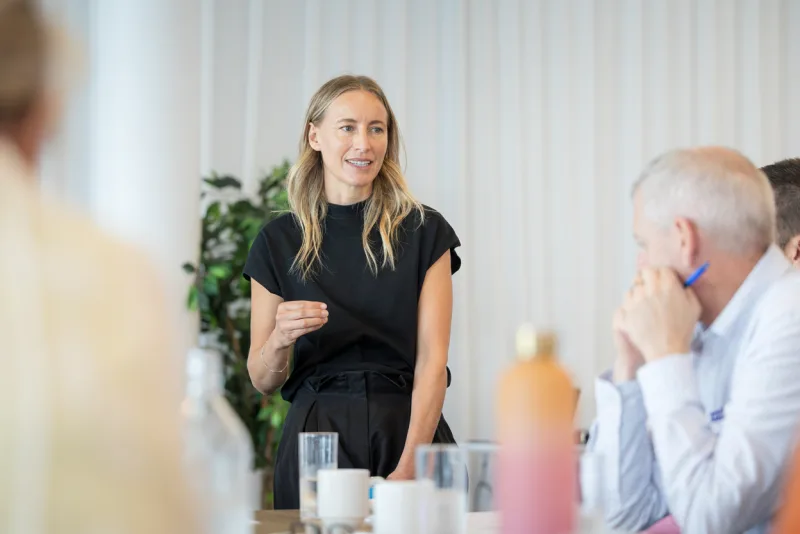
Emily Rust
Founder, Stones
Featured
Good morning. Today we're unveiling one of the biggest secrets of leadership: Most of what determines whether you're effective as a leader isn't technical or personality-based. It's structural.
We’ve been percolating on this idea for a while now, and the more we talk to leaders across different industries and roles, the more the same pattern shows up. The leaders who create sustainable performance tend to focus their attention on four core dimensions. Not dozens of techniques. Not endless frameworks. Just the small number of foundations that shape everything else.
You could think of them as four “general leadership” responsibilities every leader carries.
Regardless of level, industry, experience. When you rise through the technical ranks of being a “high performer” in your role, you land in “leadership” where, not only do you need to lead a technical domain, but now have responsibility for a broad array of business and people leadership things that you were never taught before the promotion.
Leading Self
Everything starts here, and this is also where most leaders are running on fumes.
Your clarity, your energy, your judgement. The values you're actually operating from (not just the ones on the wall). When this is working, it's almost invisible. When it isn't, it bleeds into everything: your decisions, your relationships, your culture.
Research from the Centre for Creative Leadership found that a lack of self-awareness is one of the most consistent predictors of leadership derailment. Not a lack of technical skill. Not missing knowledge. A disconnect from self.
The leaders who sustain performance over time tend to know themselves well (and have higher self awareness), and they protect the habits that keep them grounded, especially under pressure.
Leading People
Nothing meaningful in organisations happens alone.
Leadership is expressed through the quality of your relationships: the trust you build, the conversations you have (or avoid), the expectations you set, and the environment your people get to operate in.
Here's what Google found after years of research into what makes teams most effective: who is on the team matters far less than how the team operates together.
The highest-performing teams weren't the ones with the most talent in the room. They were the ones where people felt safe to say what was actually true, where trust had been built deliberately, and where the relational fabric was strong enough to hold difficulty, dissent, and robust dialogue without fracturing.
That doesn't happen by accident. It's built through hundreds of small choices: the conversations a leader initiates (or avoids), the expectations they set, the environment they create day to day.
This is where culture, resilience, agility and performance are actually created.
Operations, and leading the Work
Even the strongest people with the best intentions need structure.
The work itself needs an operating system: clear priorities, decision rights, rhythms, and systems that turn strategy into repeatable execution.
Without that structure, the leader becomes the system. Carrying decisions, alignment, and momentum personally. It's exhausting, and as requirements scale, the weight on leaders becomes proportionately heavier.
One of the most striking findings from McKinsey's research on organisational health is that companies with strong operational discipline (clear accountabilities, well-defined processes, and consistent follow-through) significantly outperform their peers on long-term returns.
It turns out that structure isn't the enemy of creativity or culture. It's what makes both sustainable.
Strategy, and leading the Future
And then there's the horizon.
Markets shift. Technology evolves. Expectations change. Leaders are constantly balancing the pressures of today with the signals of tomorrow.
Strategic leadership isn't about predicting the future. It's about building the awareness and capability to respond to it deliberately, rather than reactively, when the ground has already shifted beneath you.
It's about building the habit of lifting your head and zooming out, regularly, deliberately, to ask whether the direction you're heading is still the right one.
Across these four domains sits the real work of leadership.
And for most leaders, the challenge isn't knowing these things matter. It's finding the space to step back and design them intentionally.
Because the reality is that the operational demands of the week will always win. Most leaders spend the majority of their time inside the system, with very little room to work on their leadership of it.
The urgent crowds out the important. And slowly, by default rather than design, leadership shapes itself around whatever problem is in front of you, rather than where you actually want to go.
Three things to try this week
- 1
Audit where your time actually went last week.
Not where you intended it to go: where it actually went. Across those four domains (self, people, operations, strategy), which got your attention? Which got almost none? That gap is data.
- 2
Protect one "on the leadership" hour.
Block sixty minutes this week, not for tasks, not for meetings, for thinking about how you're leading. Use it to reflect, plan a conversation you've been avoiding, or sketch out a system that's been running on goodwill rather than structure.
- 3
Ask your team one honest question.
"What's one thing that would make your work easier or clearer right now?" Then listen without fixing. The answer will tell you more about where your people leadership needs attention than most performance reviews will.
If you've felt the gap between the leader you intend to be and the one the week produces, we've built something for that.
This Thursday we're hosting the inaugural Pathfinder event in Auckland, a one-day offsite for leaders who want to step out of the operational noise and think clearly about the year ahead.
The day is built around those four domains. Across four facilitated sessions, you reflect, pressure-test your thinking with peers, and identify the small number of shifts that will genuinely move the needle, in your leadership, and in your organisation.
You leave with a one-page Leadership Blueprint for the next 12 months. Concrete. Prioritised. Yours.
There are still a small number of places available for Thursday.
Learn more about Pathfinder → https://leadwithstones.com/events/stones-pathfinder
And because you’re a valued member of the Stones community, you are entitled to a generous, friendly discount, making your ticket only $165 for the day.
Use code: REVVEDFRIENDLIES at checkout.
Looking across those four domains, self, people, operations, and strategy:
Which one is most under-designed in your leadership right now?
That's often where the biggest leverage sits.
That's all for this week's briefing.
Emily Rust · Founder, Stones
The archive
Every past edition
Browse the back catalogue. One leadership idea per week, all in one place.
The Tuesday Briefing
One idea, every Tuesday.
Join the leaders who start their week with one practical idea worth acting on.